Last updated:
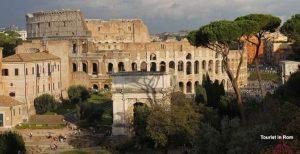
The Colosseum, originally called the Flavian Amphitheatre, is an iconic symbol of Rome and one of the most famous landmarks in the world.


Colosseum fact sheet
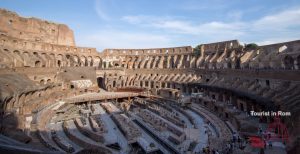
The Colosseum is the largest amphitheatre in the world. The elliptical building had 80 entrances, is approximately 188 m long and 156 m wide, the arena measures 86 m by 54 m, and the basement 76 m x 44 m.
| Construction period: | 72-80 AD, under the emperors Vespasian, Titus and Domitian |
| Height: | 48.5m originally 52m |
| Floor area of the oval building: | ~ 20,000 sq m |
| Length x maximum width: | 187.5m x 156.5m |
| Area of the arena: | 3,357 sq m |
| Dimensions of the arena: | 86m x 54m |
| Number of entrances: | 80 entrances |
| Spectators: | 50,000 – 87,000 |
| Weight: | 250,000 tons |
| Load on the foundations: | 110 t/square meter |
| Masonry: | 100,000 cubic meters in travertine, tuff and brick with marble cladding, 300 tons of iron |
| Visitors: | over 12,000,000 a year |
History and Building History
The Colosseum was built by the Roman emperors Vespasian and his son Titus and inaugurated in 80 AD by Emperor Titus. It could hold up to 80,000 spectators and was used for a variety of events, including gladiator fights, animal hunts, and theatrical performances.
The Colosseum is a marvel of engineering, with an intricate system of arches, vaults, and passageways that allowed people and animals to enter and exit the arena quickly and efficiently. The technology is comparable to that of modern stadiums. It was the model for all brick amphitheatres in the Roman Empire.
Previously, during the fire of Rome in 64 AD, the theatre built by Statilius Taurus for gladiator games on the Field of Mars had burned down. No remains have survived, and its exact location is unknown.
After the death of Nero and the civil war, in which three emperors died within a year, Vespasian of the Flavian dynasty reorganized the Roman Empire. He erected the Flavian Amphitheatre exactly where an artificial lake of Nero’s Domus Aurea had previously stood, erasing the memory of Nero. A colossal bronze statue of Nero, the Colossus of Nero, stood nearby. It was said to be about 35 metres high – Nero’s model was the Colossus of Rhodes, one of the Seven Wonders of the Ancient World. The colossus was transformed into the sun god and erected in front of the theatre. The name Colosseum is attributed to this colossus, although the name has only been recorded since the early Middle Ages.
Construction began around 70 to 72 AD. For the inauguration in 80 AD, Emperor Titus organized games said to have lasted 100 days: in addition to gladiator fights and animal hunts, in which 5,000 animals are said to have been killed, even naval battles were re-enacted.
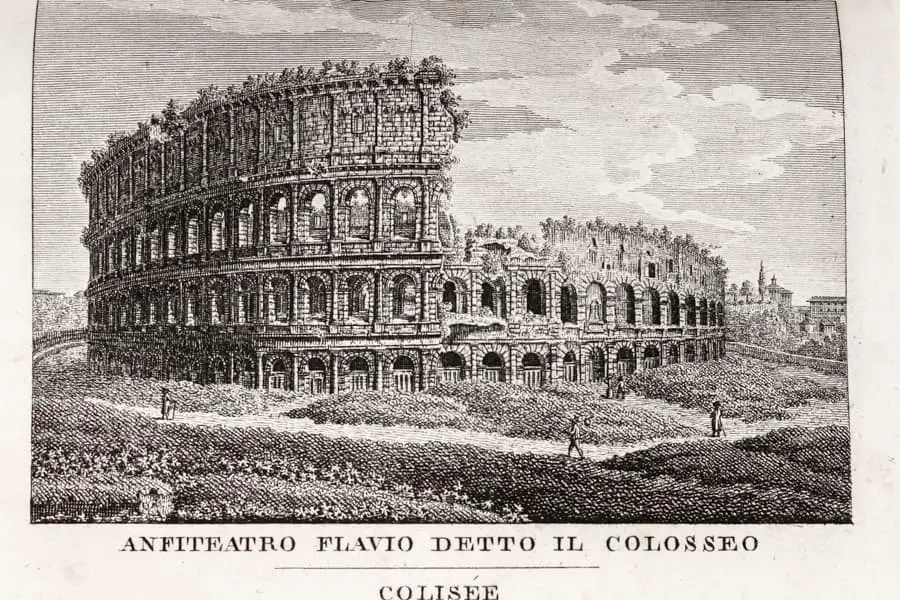
Over the centuries, the Colosseum was renovated and restored several times. It was damaged by earthquakes and fires. The last gladiator fights took place in 434/435 AD, and the last animal hunt is recorded in 523 AD. After the games were over, the Colosseum served as a residential and stable building, for occult rites, and as a quarry for the construction of churches and palaces. Valuable materials such as travertine, marble and bronze were systematically stripped.
Spectators enjoyed the exciting spectacle of animal hunts, gladiators and executions with fruit, olives, bread and wine.
Archaeological report on the Colosseum
by Heinz-Jürgen Beste, German Archaeological Institute Rome

Heinz-Jürgen Beste of the German Archaeological Institute in Rome has been researching the basement of the Colosseum since 1996, in cooperation with universities and the Soprintendenza Archeologica di Roma.
In the following report, he describes the construction phases of the amphitheatre, the history of its excavation, and the findings on ancient stage technology.a di Roma.
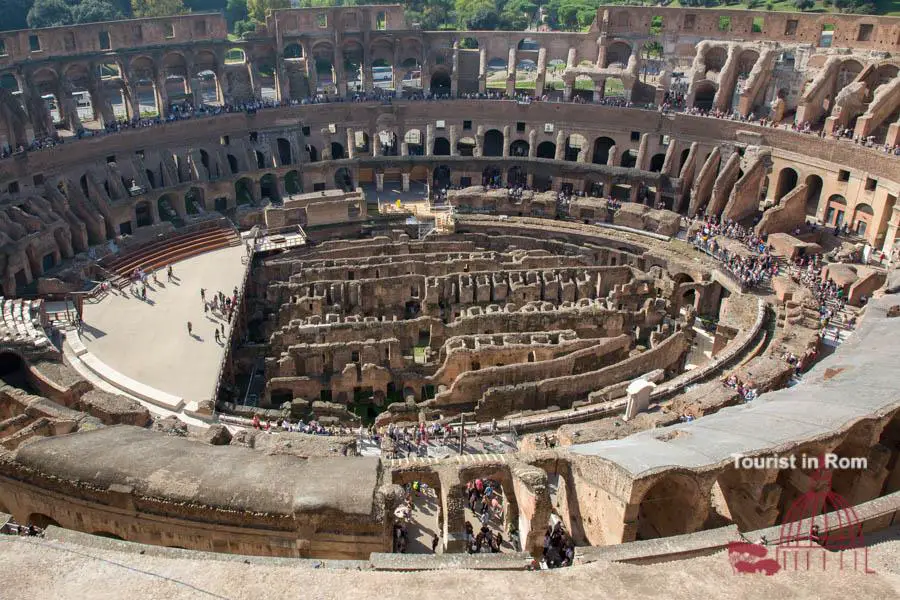
The Flavian Amphitheater is one of the highest achievements of Roman civil engineering, for which the huge dimensions, the short construction period of less than ten years, the capacity of fifty thousand spectators and the perfect organization of the stream of visitors give a vivid testimony. The building influenced strongly the shape of the Roman amphitheater, as the great theaters in Italy and in the provinces show its archetype.
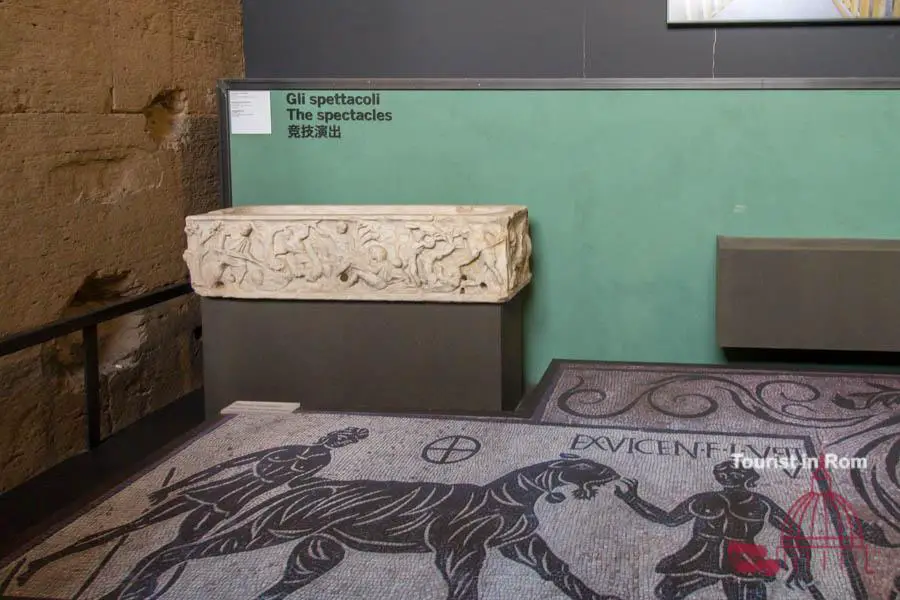
After the city fire of 64 AD, Emperor Nero had transformed the area between Esquiline, Caelius and Palatine into his private estate, the Domus Aurea. During the reign of Emperor Vespasian, this was returned to the public and built with public buildings, which centered on the Colosseum. The works probably began in the years 70 to 72 AD. Gladiator schools, depots for weapons and stage decoration and other infrastructure were among them. The amphitheater was inaugurated in the year 80 AD by Emperor Titus. During the hundred-day inauguration ceremony a sea battle was organized in the Colosseum in addition to gladiatorial fighting and animal hunts. Completed was the entire plant probably in the nineties of the first century AD. The last reported animal hunt took place in 523 AD and henceforth the construction largely served as a quarry. The current name Colosseum occurred only in the eighth century.
The first systematic excavation took place from 1806 to 1814 by the Roman archaeologist Carlo Fea. Because of the high groundwater level, the excavation had to be stopped soon and filled up again. Only 1874 to 1876 it was possible to expose the eastern part of the basement. The until then buried western part was excavated between 1934 and 1938, unfortunately without any documentation. In the extensive restoration in the course of this work, a large part of the ancient structure was lost.
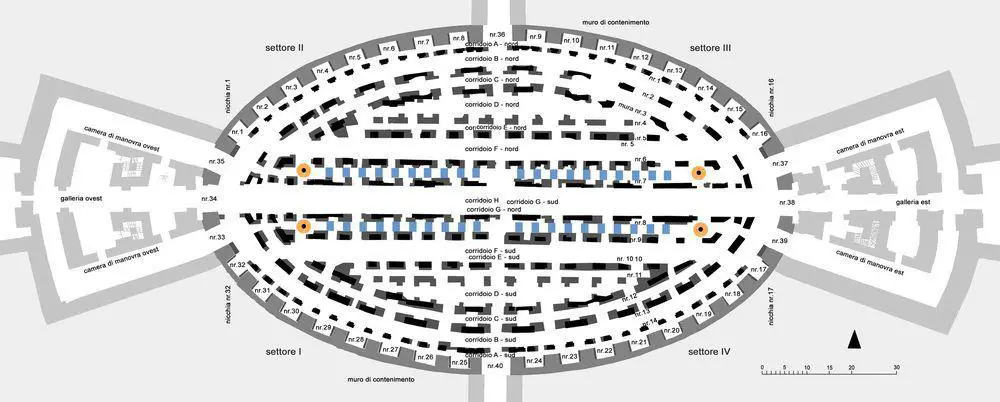
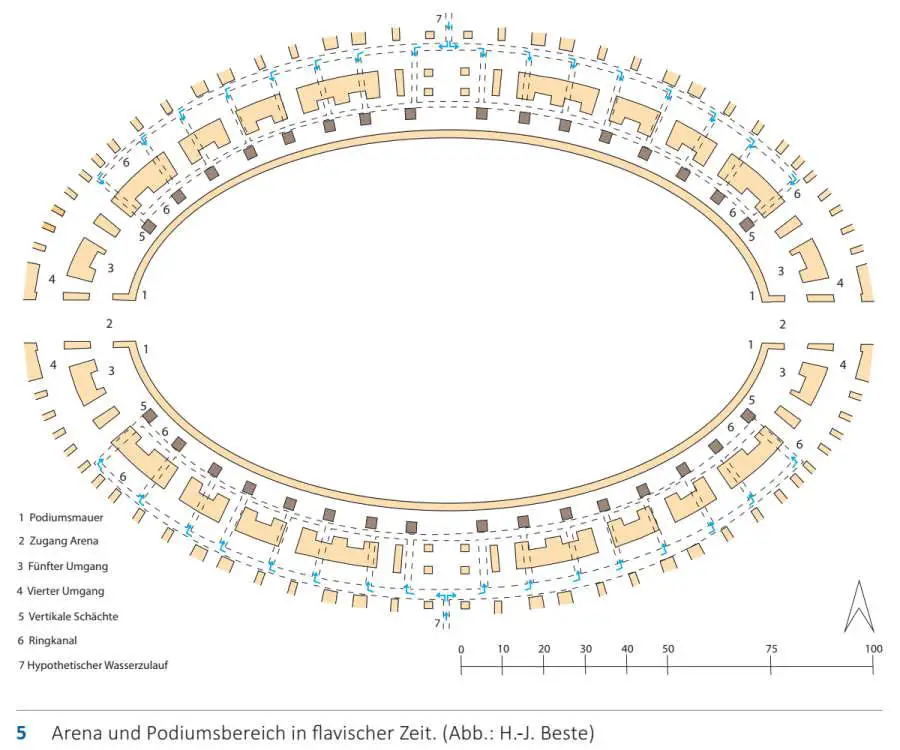
In my (DAI Rome) study and documentation of the podium and the basement, begun in 1996 in collaboration with the Roman Antiquities Administration, it was possible to distinguish between several construction phases from half a millennium of use. So far, three different systems can be located, whose installation between the end of the 1st century (81-96) and the middle of the 4th Century AD are to be set. Two of the elevator systems, those in corridors B, F and H, belong to the construction phase of the Colosseum, due to structural details, and can thus be dated to the Flavian period.
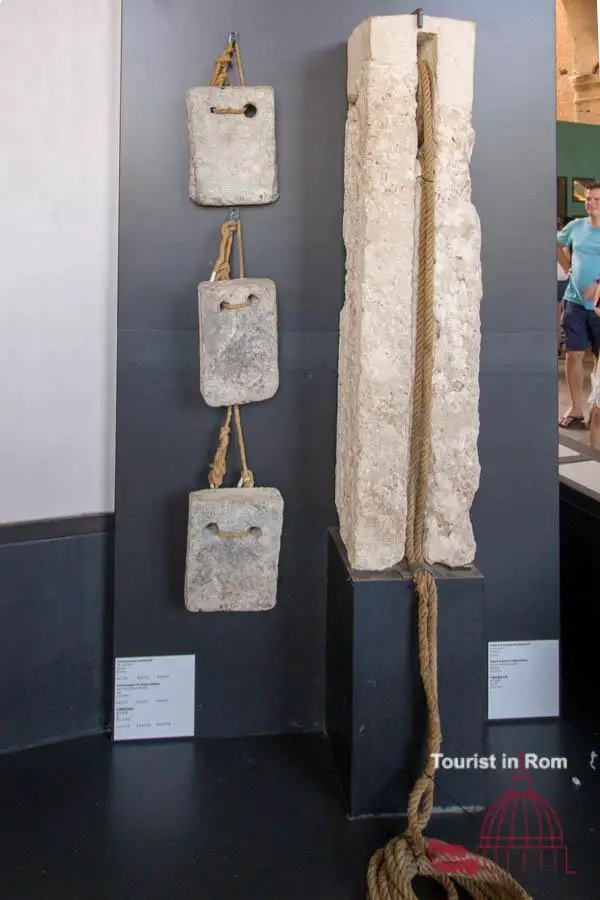
For corridor B, an elevator system with 28 cages was used to transport animals up to the size of a cat or a bear into the arena. Corridors F and H complete the elevator system in the basement, since there was a system of 20 movable platforms about 4 x 5 m in height, by means of which large decorations were pulled up to give a showcase to the animal hunting (venationes).
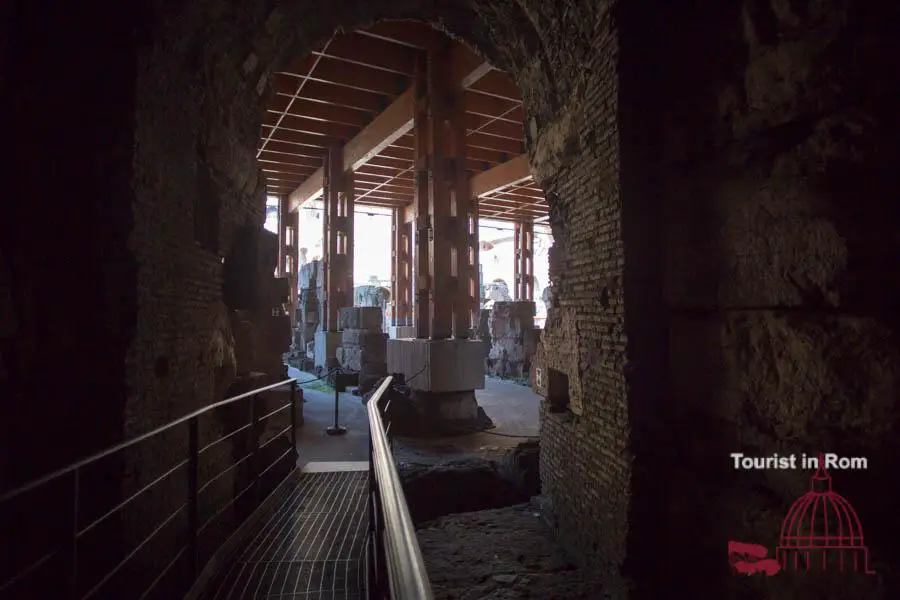
Due to a fire disaster in the Colosseum caused by a lightning strike in 217 AD, and the consequent restoration work that lasted nearly twenty years, there was a need to stabilize the wall structure in the basement, rendering the two previous elevator systems useless. In this respect, a new elevator system was built in Corridors E and G with which 60 cages could be moved. However, due to the limited space in the corridors E and G, it was necessary to abandon the previous elevator model – winch, elevator cage, winch, elevator cage, etc. – and hoist several cages with one winch.
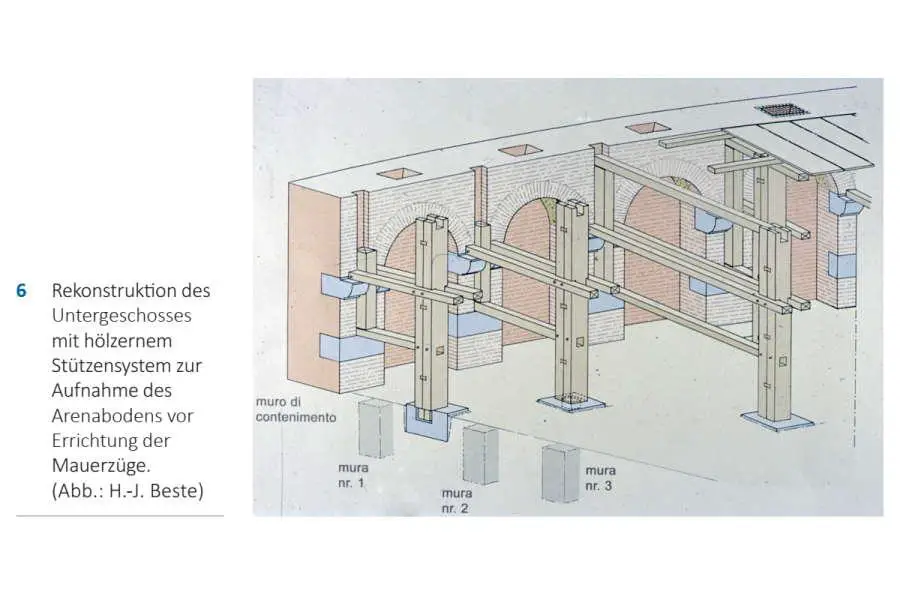
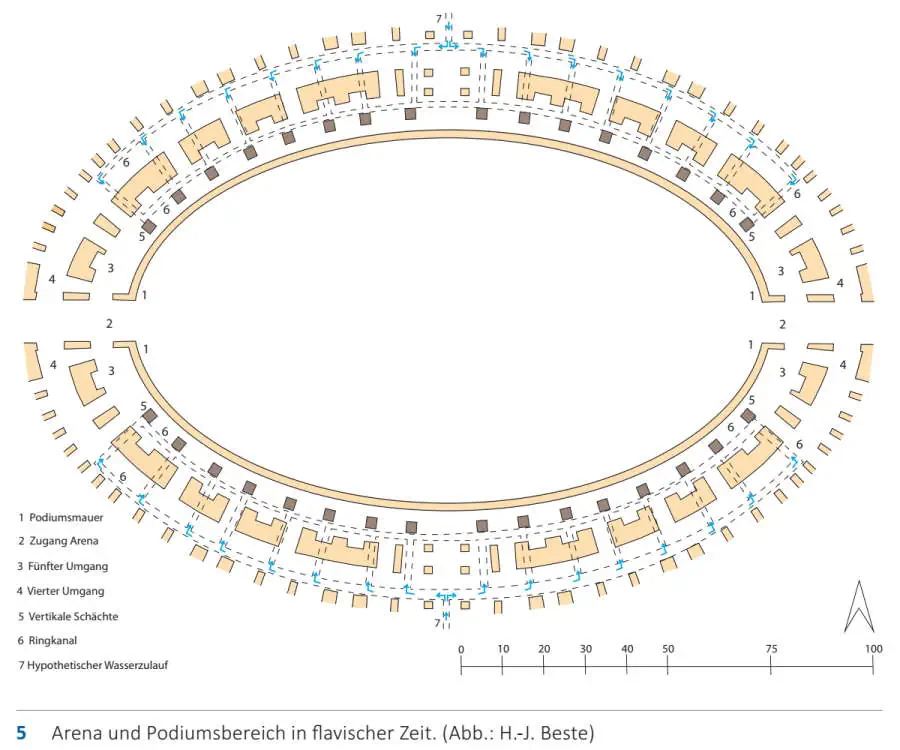
In addition to focusing on the function of the basement, it was also possible to make statements about the location and course of the naval battle (Naumachia) at the inauguration and the division of seats for the senators.
The desire of the Antiquities Authority to restore the arena was met by the year 2000 in collaboration with the University La Sapienza. For didactic and monument preservation reasons, only about a seventh of the total area in the east of the arena was covered. This part was so heavily destroyed by the excavation and subsequent restoration of 1875 that could easily be set the new support system on the ancient foundations. The examination of this project showed that the arena’s ground in antiquity was completely renewed at least twice, its running level raised and its wooden structure profoundly changed.
History and events in the Colosseum
by Heinz-Jürgen Beste, DAI Rom
In this report, Heinz-Jürgen Beste focuses on the daily life of the games: the organization of events, the logistics behind the scenes, and the sophisticated elevator system that brought animals and stage sets up into the arena.
The Romans loved their games: Thousands flocked to the huge arena on match days to watch animal raids and gladiatorial combat. It was a bloody pleasure. Death was omnipresent, though not every fight ended lethally. After all, the training of the gladiators cost time and money, which wanted to be well invested. The effort that the emperors drove as playmakers is still immense for today’s circumstances: For some celebrations, which could last several days, they brought hundreds of wild animals from all areas of the empire to Rome. Elephants and bears, deer, antelopes, wild boars and wolves …
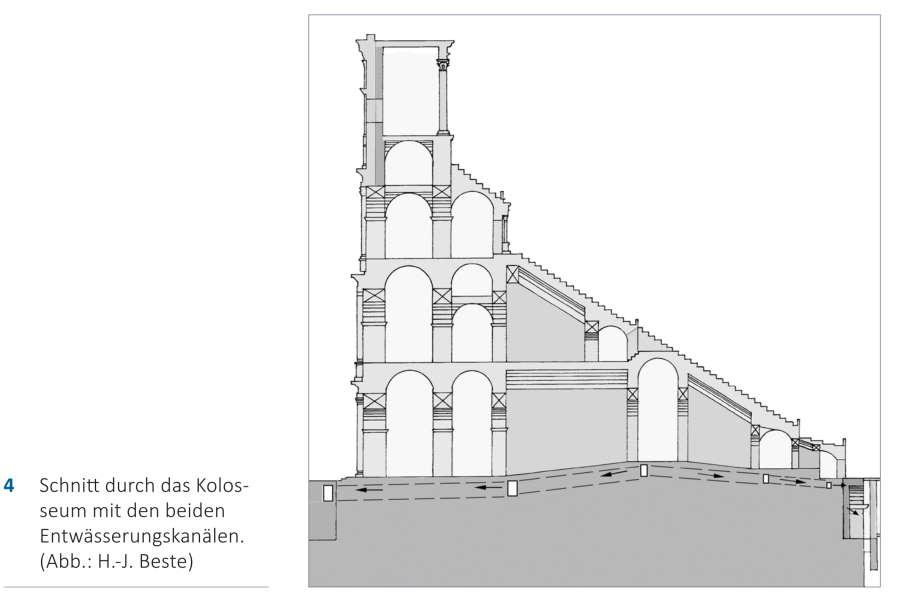
As brutal as the games were, their process was well thought-out and so refined was the infrastructure that made the realization of the shows possible. It is estimated that up to 50,000 people were seated on the ranks of the Flavian Amphitheater. An ingenious route system ensured that the crowds came smoothly to the ranks and, after the end of the performance, also quickly outside.
The pleasure of one was the work of the other. Hundreds of slaves and workers were in the background to ensure that the performance went smoothly on the stage. A sophisticated elevator system helped.
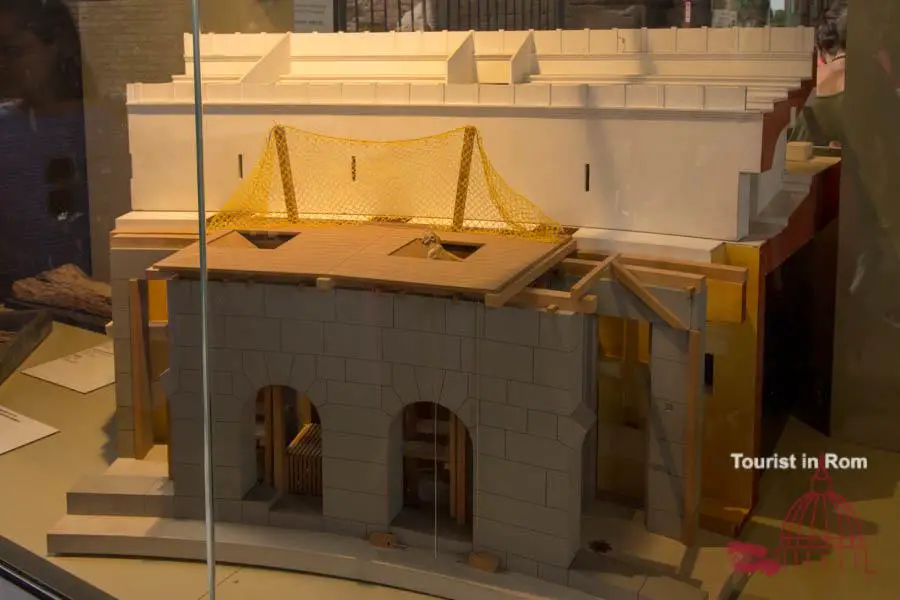
The ancient writers repeatedly report that animals and fighters appeared out of nowhere in the arena. Researchers have therefore long suspected that there must have been lifts in the basement of the Colosseum, with which even entire sets could be moved upwards.
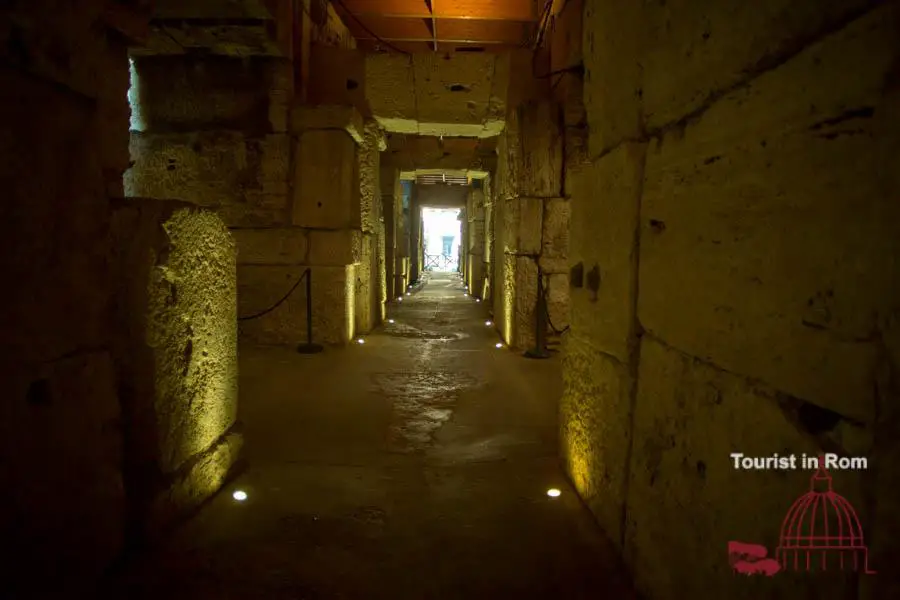
In recent years, archaeologists and building researchers of the Archaeological Monuments Office of the city of Rome and the German Archaeological Institute have studied in detail the entire basement. It succeeded in bringing some secrets of the lifts to light.
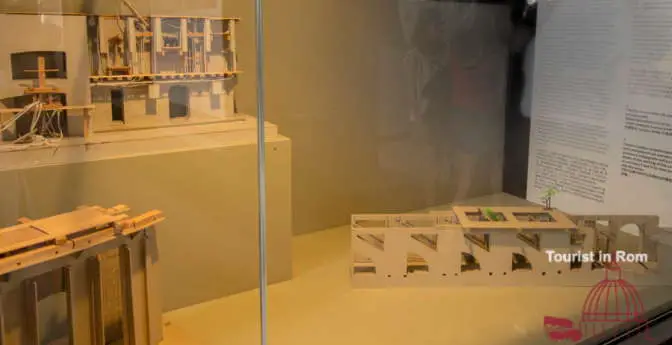
Since steam and electric drive were not yet available, on the other hand, muscle power was available at low cost, the lifts were powered by winches. So that the elevators did not obstruct the view of the arena, the elevator cabins were only pulled up to below the arena floor. The last meters were covered by the animals over ramps, which could be folded down from the arena floor by counterweights.
The elevator systems of the first phase were not in operation for a long time. A few years after opening, the statics of the arena-supporting walls had to be improved. The elevators were moved to the center of the arena, where they were less vulnerable.
Frequently Asked Questions about the Colosseum
When was the Colosseum built?
Construction began around 70 to 72 AD under Emperor Vespasian. The amphitheatre was inaugurated in 80 AD by his son, Emperor Titus. The entire complex was probably completed in the 90s of the first century AD.
How many spectators could the Colosseum hold?
The Colosseum could hold between 50,000 and 80,000 spectators. An ingenious system of passageways ensured that crowds could reach their seats smoothly and leave the building just as quickly at the end of the show.
What does the name Colosseum mean?
The official name is Amphitheatrum Flavium. The name Colosseum is attributed to the Colossus of Nero, a bronze statue approximately 35 metres high that stood near the amphitheatre. The name has only been recorded since the early Middle Ages.
What was in the basement of the Colosseum?
The basement housed all the stage technology for the games: a sophisticated system of elevators that transported animals, gladiators and stage sets into the arena. Archaeologists from the German Archaeological Institute in Rome have been documenting several construction phases of these systems since 1996.
How did the Colosseum fall into ruin?
After the last games in the 6th century, the Colosseum served as a quarry for the construction of churches and palaces. Travertine, marble and bronze were systematically stripped. Earthquakes and fires caused further damage over the centuries. The current state is the result of this long history of decay.
Where did the emperor sit in the Colosseum?
question of the exact location of the imperial box puzzled historians for decades. Recent research by Heinz-Jürgen Beste (DAI Rome) and Rossella Rea now provides clear evidence: the imperial box was most likely located in the northern section of the amphitheatre. It was approximately 10.5 × 4 metres in size, fully clad in marble, and positioned significantly higher than the senators’ seats. → New findings on the podium and imperial box
When did the last games take place in the Colosseum
? The last gladiator fights took place in 434/435 AD. The last recorded animal hunt was in 523 AD. After that, the Colosseum served as a quarry, residential building and stable.